On this page
- What is answer engine optimization?
- AEO vs SEO: what is different?
- How does answer engine optimization work?
- Why AEO matters now
- Run an AI visibility check
- How to check AI brand mentions
- How to see AI mentions by model
- How to see ChatGPT mentions
- How to see Claude mentions
- How to see Gemini mentions
- How to see Perplexity mentions
- How to see Grok mentions
- How to see DeepSeek mentions
- How to see Google AI Overviews mentions
- How to see Bing Copilot mentions
- How to do answer engine optimization
- Best AEO tools for 2026: what to look for
- AEO content optimization
- AI brand visibility tracking
- Common AEO mistakes
- References and further reading
- FAQ
What is answer engine optimization (AEO)? AEO vs SEO, tools, and AI brand visibility
A practical guide to AEO, AI visibility checks, AI brand mentions, and how to see whether major AI models mention your brand.
Updated September 7, 2026
Answer engine optimization, usually shortened to AEO, is the work of making your brand easy for AI answer engines to understand, mention, and describe correctly. SEO helps you earn rankings in search results. AEO helps you show up inside the answer itself.
That matters because buyers now ask ChatGPT, Claude, Gemini, Perplexity, Grok, DeepSeek, Google AI Overviews, and Bing Copilot for product advice, comparisons, category shortlists, and "best tool" recommendations. If those systems do not know who you are, what you do, who you serve, and why you are credible, your brand can disappear from the conversation before a visitor ever reaches Google.
This guide explains what AEO is, how answer engine optimization works, how AEO vs SEO differs, which AEO tools matter in 2026, and how to use Layzr for AI visibility checks, AI visibility scores, AI brand mention checks, custom prompts, and multi-model AI brand monitoring. If you are also preparing pages for AI agents, read the Lighthouse agentic browsing guide alongside this one.
What is answer engine optimization?
Answer engine optimization is the process of improving how your brand appears in AI-generated answers. In practice, that means making your website, content, entity signals, product positioning, and proof easier for answer engines to understand and repeat.
AEO is often called AI search optimization, generative engine optimization, or AI visibility work. The wording changes, but the job is the same: help answer engines find the right facts about your brand and include you when someone asks a question your business should answer.
AEO vs SEO: what is different?
SEO is still worth doing. Search engines still drive demand, and the same content that helps Google understand a page often helps AI systems understand it too. The difference is the output you are optimizing for.
- SEO asks: can this page rank for a search query?
- AEO asks: will an AI answer mention this brand and describe it correctly?
- SEO reports rankings, clicks, impressions, CTR, backlinks, and indexed pages.
- AEO reports AI visibility score, brand mentions, model coverage, competitor mentions, sentiment, and answer accuracy.
- SEO usually sends people to a page. AEO may influence the decision before the click happens.
How does answer engine optimization work?
Answer engines use a mix of model knowledge, search results, structured data, trusted sources, and content patterns to generate responses. You cannot control every answer. You can control whether your brand gives models enough clear material to work with.
- Map the questions buyers ask before they know your brand.
- Check whether AI models mention you for those questions.
- Compare how each model describes your product, category, audience, pricing, and alternatives.
- Find missing facts, weak positioning, unclear pages, and outdated descriptions.
- Update the pages and sources that answer engines are likely to use.
- Run the same prompts again so you can see whether AI visibility moved.
This is where an AEO tool matters. Manually opening every model, pasting the same prompt, saving answers, checking rankings, and comparing competitors gets messy fast. Layzr turns that into a repeatable AI visibility check.
Why AEO matters now
Webflow describes AEO as the practice of improving how brands get mentioned in AI-generated answers from tools like ChatGPT, Perplexity, and Google AI Overviews. Their AEO page also frames content, technical structure, authority, and measurement as the main areas that affect AI-driven discovery.
The execution gap is real. Webflow's AEO Divide report says 68% of marketing leaders report some level of AEO maturity, while only 26% of practitioners say they are actively implementing it. In plain English: leadership knows AI search matters, but teams still need measurement, ownership, and a weekly workflow.
- AI answers can summarize a category before a user ever sees search results.
- A missing brand mention can remove you from a shortlist.
- A wrong brand description can send buyers to the wrong conclusion.
- A competitor mention can reveal which sources and claims models trust more than yours.
- AEO measurement gives your team a baseline instead of a hunch.
Run an AI visibility check
An AI visibility check answers a simple question: when people ask AI tools about your category, problem, brand, or competitors, do you show up?
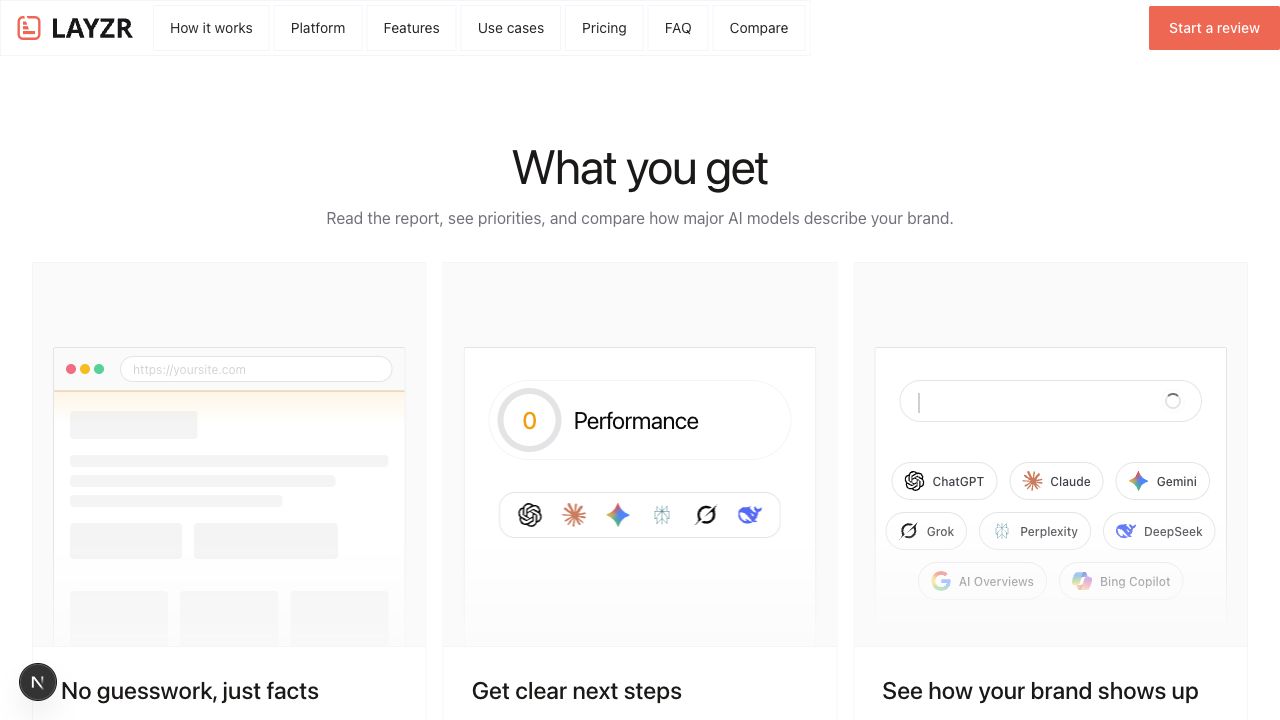
Layzr checks AI visibility across the major models and answer surfaces your buyers are likely to use: ChatGPT, Claude, Gemini, Perplexity, Grok, DeepSeek, Google AI Overviews, and Bing Copilot. You can test category prompts, comparison prompts, branded prompts, and custom prompts you already care about for SEO.
- Use AI visibility score to see the health of your presence at a glance.
- Use prompt-level results to see which questions include or exclude your brand.
- Use model comparisons to see where one answer engine understands you better than another.
- Use competitor mentions to learn who appears when you do not.
- Use recommendations to decide what page or claim to fix first.
How to check AI brand mentions
AI brand mentions are the answers where a model names your company, describes what you do, compares you with competitors, or cites you as a source. A brand mention can be good, weak, missing, or wrong.
- Open Layzr and choose the website workspace you want to monitor.
- Run AI brand mentions to ask the supported models about your brand.
- Review whether each model recognizes the company, category, audience, and product.
- Look for wrong facts, vague descriptions, outdated positioning, missing competitors, and weak recommendations.
- Save the prompts that matter so you can rerun them after copy, SEO, or product changes.
How to see AI mentions by model
Each model has its own memory, retrieval behavior, and answer style. AEO measurement gets more useful when you compare the same prompts across models instead of trusting one chatbot as the whole market.
- How to see ChatGPT mentionsCheck whether ChatGPT names your brand in category, comparison, and buying-research prompts.
- How to see Claude mentionsCheck how Claude explains your brand, audience, and product positioning.
- How to see Gemini mentionsCheck whether Gemini includes your brand for product and category questions.
- How to see Perplexity mentionsCheck search-style AI answers, rankings, and competitor mentions in Perplexity.
- How to see Grok mentionsCheck whether Grok recognizes your brand for the same discovery prompts.
- How to see DeepSeek mentionsCheck how DeepSeek answers brand, category, and alternative questions.
- How to see Google AI Overviews mentionsCheck whether your brand appears in Google AI Overviews-style answer surfaces.
- How to see Bing Copilot mentionsCheck whether Bing Copilot includes your brand in AI-assisted search answers.
How to see ChatGPT mentions
In Layzr, run a custom prompt set through ChatGPT and review whether your brand appears in the answer. Start with buyer questions like 'best AEO tools,' 'best AI visibility tools,' 'alternatives to [competitor],' and 'what tool should I use to track AI brand mentions?'
For ChatGPT mentions, look at three things: whether the brand appears, whether the description is accurate, and whether the answer gives enough reason to choose you.
How to see Claude mentions
Run the same prompts in Claude from Layzr so the comparison stays fair. Claude may phrase recommendations differently from ChatGPT, so do not stop at a yes or no mention. Check whether it understands your audience, use case, and category.
How to see Gemini mentions
Use Gemini mention checks to see whether your brand is visible in Google's AI model answers. This is useful for AEO because many buyers already move between Google Search, Gemini, and AI-generated summaries while researching tools.
How to see Perplexity mentions
Perplexity behaves more like an AI search engine than a pure chatbot. In Layzr, check whether Perplexity mentions your brand, which competitors appear next to you, and whether the answer points to sources that support or weaken your positioning.
How to see Grok mentions
Run Grok checks for the same category and comparison prompts you use elsewhere. If Grok omits your brand while other models include it, that is a signal to strengthen public brand signals and make the core positioning easier to verify.
How to see DeepSeek mentions
Use DeepSeek mention checks to compare whether another major model understands the same facts about your company. Watch for partial recognition: the model may know the brand name but miss the product category, audience, or current feature set.
How to see Google AI Overviews mentions
Google AI Overviews can answer a search before a user scrolls into the standard results. In Layzr, use Google AI Overviews checks to see whether your brand appears for search-like questions and whether the answer lines up with the pages you want Google to understand.
How to see Bing Copilot mentions
Bing Copilot matters because some buyers use Microsoft search and Copilot-style answers for research. In Layzr, compare Bing Copilot results against ChatGPT, Claude, Gemini, Perplexity, Grok, DeepSeek, and Google AI Overviews so you can see where your AI visibility is uneven.
How to do answer engine optimization
AEO gets easier when you stop treating it as a vague content trend and treat it as a measurement loop. Check the answers, fix the source material, then check again.
- Define the prompts that should mention you: category, problem, alternative, comparison, pricing, use case, and brand questions.
- Run an AI visibility check in Layzr to see where you appear today.
- Run AI brand mentions to see whether models describe you accurately.
- Compare model results side by side instead of trusting one answer engine.
- Update pages that explain your product, category, customer, features, pricing, proof, and competitors.
- Add answer-ready sections that directly respond to buyer questions.
- Use structured data, clean metadata, internal links, and a crawlable site structure so machines can read the page.
- Track the same prompts over time so you know whether changes helped.
Best AEO tools for 2026: what to look for
When people search for the best AEO tools or top AEO tools for AI search visibility analytics, they are usually looking for one of three things: measurement, content fixes, or monitoring. The strongest AEO tool should handle all three without forcing your team to maintain a spreadsheet of chatbot answers.
- AI visibility check across more than one model.
- AI visibility score so trends are easy to explain.
- AI brand mention checks for accuracy, recall, and positioning.
- Custom prompts for the exact questions your buyers ask.
- Competitor mention tracking.
- Saved model answers for direct review.
- Content optimization recommendations tied to real model answers.
- Recurring monitoring so AEO becomes a workflow, not a one-time report.
Layzr is built for this version of AEO: AI visibility, AI brand mentions, custom prompts, model comparisons, page audits, and scheduled monitoring in one workflow. That makes it a practical fit for teams comparing AEO tools in 2026.
AEO content optimization
Keyword stuffing will not solve AEO. The page has to make the answer obvious. If a model has to guess what you sell, who it is for, or why it is different, your brand mention will be weak even if the page looks polished.
- Put a clear product description near the top of important pages.
- Write direct answers to buyer questions instead of hiding them in long narrative copy.
- Name your category, audience, use cases, features, and alternatives in plain language.
- Add proof that a model can understand: examples, customer types, specific outcomes, screenshots, and comparison pages.
- Use internal links to connect your homepage, product pages, comparison pages, docs, guides, Search Console setup, and pricing.
- Keep facts consistent across your site, social profiles, directories, docs, and third-party listings.
AI brand visibility tracking
AI brand visibility tracking is the ongoing version of an AEO audit. You are watching whether models mention your brand, whether the answer is accurate, whether competitors keep appearing, and whether your score improves after you change the site.
Layzr supports scheduled AI SEO runs, AI visibility checks, AI brand mentions, and saved custom prompts. That means you can monitor brand presence in generative AI without manually checking every model every week.
- Track if AI mentions your brand for discovery prompts.
- Track what AI says about your brand.
- Track brand presence in generative AI over time.
- Track competitor mentions beside your brand.
- Track whether a new page, comparison, or positioning update changes model answers.
Common AEO mistakes
- Checking only ChatGPT and assuming every answer engine behaves the same.
- Tracking brand mentions without checking whether the description is accurate.
- Writing generic FAQ content that does not answer real buyer prompts.
- Ignoring competitor prompts, alternative prompts, and comparison prompts.
- Treating AEO as a one-time audit instead of recurring visibility tracking.
- Trying to improve AI mentions without fixing the pages models use to understand the brand.
References and further reading
- Webflow: AEOWebflow's overview of AEO, AI-driven discovery, and AEO measurement pillars.
- Webflow: The AEO DivideWebflow's 2026 report on AEO maturity, execution gaps, ownership, and measurement.
- Layzr changelog: AI visibility checksLayzr product notes on AI visibility checks, AI brand mentions, custom prompts, and scheduled AI SEO runs.
FAQ
What is answer engine optimization?
Answer engine optimization, or AEO, is the process of improving how your brand appears in AI-generated answers. It focuses on mentions, answer accuracy, model understanding, and AI search visibility.
What is AEO answer engine optimization?
AEO answer engine optimization means making your website and brand signals clear enough for answer engines like ChatGPT, Claude, Gemini, Perplexity, Grok, DeepSeek, Google AI Overviews, and Bing Copilot to mention and describe you accurately.
What is answer engine optimization AEO vs SEO?
SEO focuses on search rankings and clicks. AEO focuses on whether AI answer engines include your brand inside the answer, describe it correctly, cite the right sources, and compare it accurately against competitors.
How does answer engine optimization work?
AEO works by measuring current AI visibility, finding missing or wrong model answers, improving the content and signals models rely on, then rerunning the same prompts to see whether visibility improved.
How do I see if AI mentions my brand?
Use Layzr to run AI visibility checks and AI brand mention checks across ChatGPT, Claude, Gemini, Perplexity, Grok, DeepSeek, Google AI Overviews, and Bing Copilot. Review whether your brand appears, how it is described, and which competitors appear nearby.
Why should I track AI brand visibility?
You should track AI brand visibility because AI answers can shape a buyer's shortlist before they visit your site. Tracking shows whether your brand is present, missing, misrepresented, or losing space to competitors.
What are the best tools for answer engine optimization?
The best AEO tools check AI visibility across multiple models, track brand mentions, score visibility over time, support custom prompts, compare competitors, and turn model answers into content and SEO fixes. Layzr is built around that workflow.
What is an AI brand visibility tool?
An AI brand visibility tool checks whether AI systems mention your brand for the prompts your buyers ask. Layzr adds AI visibility score, AI brand mentions, model comparisons, custom prompts, page audits, and scheduled monitoring.
Are best AEO tools 2025 lists still useful in 2026?
They can help you see which vendors existed, but AEO tools changed fast. For 2026, prioritize multi-model coverage, recurring monitoring, AI visibility scoring, custom prompts, and brand mention accuracy.
How do I optimize brand mentions in AI?
Start by measuring current mentions. Then make your product description, category, audience, comparison pages, proof, structured data, and internal links clearer. Rerun the same prompts in Layzr to see whether AI answers changed.
Check your AI visibility in Layzr
Run AI visibility checks, AI brand mention checks, custom prompts, and model comparisons across the major answer engines.
Start an AI visibility check